Advanced Things
Up until now I have been covering things that I believe every caller should know. From here on, I will be discussing things that you may never use as a caller, but I thought they were pretty cool, so I am sharing them with you.
Making Resolution more Diverse
Up until now, all patter sequences end in an allemande left, a right and left grand and a promenade. While this pattern is very reassuring to beginner dancers, in general a caller is looking to eliminate ‘ruts’ where certain sequences are called over and over.
Make promenades unambiguous
- Good calling is UNAMBIGUOUS. When you call ‘promenade’ when the couples are near home, you have made it ambiguous: Should they stop immediately or should they go all the way around? Ambiguity is BAD, so never let this happen. If you are near home when you call an allemande left, either
- Simply call ‘square your sets with a clap clap clap’
-
call a right and left grand (which takes you half way around), so that the promenade is half way (and unambiguous).
If you are halfway around when you call an allemande left either
-
Just call promenade home OR
- Just call right and left grand but tell them to square their sets.
Notice in all cases, things are unambiguous.
Eliminating the Allemande Left
- If you are at a corner box and ready to call ‘allemande left’, you can call the following sequence
Right and left Thru; Half Sashay; Pass thru; (to a right and left grand)
Instead of the allemande left. Note that this sequence can confuse beginner dancers so walk it slowly the first time if there are beginners on the floor.
- Now that single circle is a mainstream move, the following move can work when you are at a corner box
Single circle; Pass thru; (to a right and left grand)
Allemande Left from a Left Handed Wave
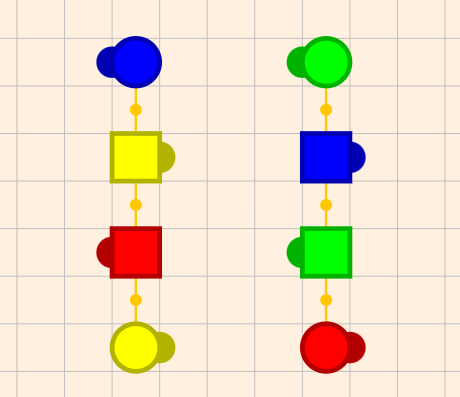
A pretty cool way of getting out of a left handed wave (e.g. after a dixie style to an ocean wave) is to call an ‘allemande left’ (since centers and ends are already holding left hands). However for this to work you need to be in a ‘left handed corner wave’, that is your square needs to look like this
| Left handed corner wave | corner box |
|---|---|
 |
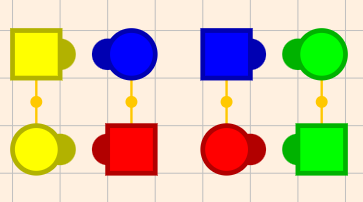 |
Notice that the left handed corner wave (on the left) looks like a corner box AFTER everyone stepped to a left handed wave (so ends and centers are holding left hands). You can get to this position from a corner box by the following sequence
Slide thru; right and left thru; dixie style; boys trade
Thus you can simply add this to any corner box resolution to make your allemande left a bit more interesting (dancers will be surprised by it, but they tend to do the right thing so they are successful, and thus like it).
Resolution by having the centers sweep a quarter.
There are some very nice resolutions that after a wheel and deal or a ferris wheel, you have the couple in the center sweep a quarter and back out to their home. This is a very nice resolution which dancers do like.
The resolutions up until now always had the potential of ‘promenade home’ at the end of them. This was nice because it meant you did not need to get your focus couple to their home, you just needed them near their corner. The resolutions described in this section are harder because
- You must resolve directly from a partner station (which is not as common)
- You must land couples exactly at home (no promenade to save you).
In the explanations below it is assumed that your focus couple is the #1 head (red) couple. Hopefully it is obvious that it will work for a side focus couple by swapping all the references to heads and sides.
- Get to partner station with all couples partnered up in lines facing in. Your #1 couple needs to be in the upper right quadrant facing in like this.
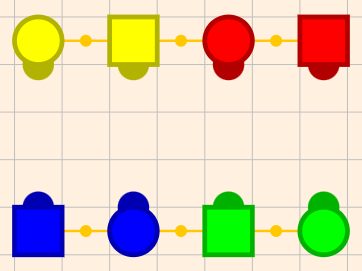
#1 (red) couple in upper right quadrant
Note that at this point it does not matter which couple is facing your #1 couple. The goal of getting here is so that a wheel and deal, will land your #1 couple at home.
- IF your head couple is FACING the #4 couple (that is the #1 man is facing his corner), then you can do a pass thru; wheel and deal centers sweep a quarter; and you are resolved (say square your sets with a clap clap clap to let the dancers know this).
- If not, call pass thru; wheel and deal. Your square will look like this.
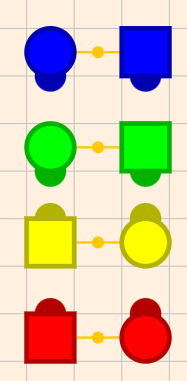
After pt; whd;
- Call centers pass thru; Notice your #1 man is NOT facing his corner at this point
- Call the following
Right and left thru; veer left; ferris wheel; centers sweep a quarter;
This is relatively easy to remember because it is the standard ferris wheel zero (rlt; vl; fw; c pt), where the last part (centers pass thru) is replaced with sweep a quarter - The square is resolved.
Note that if you notice that after the sweep a quarter your sides are swapped, you can of course simply do a sides right and left thru, but you can also do a ‘sides square thru two; allemande left’ which does not look as much like you are correcting a mistake.
Getting your #1 couple to the upper right quadrant.
The first step of the above technique is to get your #1 couple to the upper right quadrant of the square. It is tempting to do this with bend the line calls, but this often results in bad flow (the flow from a bend the line when the lines are facing in is almost always bad). Instead it is better to move your #1 couple to the correct side using Chicken Pluckers or Circulates, and then once there use a right and left thru to get the #1 couple facing the correct quadrant. To do this you will want to use couple-beside-to-couple-facing calls to get your couple from lines facing in to couples facing side walls then use circulates or pt; tb; to move the couples around. Chain down the line; flutterwheel, is also a very nice way of getting a couple turned by 90 degrees.
Finally note to get your #1 couple facing the right way, the lines facing in have to go left or right (the LINES go to the SIDEs, even if the PEOPLE are facing the head walls). Note that 2 faced lines and WAVES, which have their LONG dimension on HEAD walls, are associated with LINES facing in or out, or with BOXES that have their long dimension on SIDE walls. Thus when I talk about wanting a square oriented side to side (long dimension toward side wall or LINES facing in facing head walls), it will often involve WAVES and 2-Faced lines which have their long dimension toward head walls. Thus I do not think of the call ‘pass the ocean’ changing the ‘orientation’ of the square. There are relatively few calls that do, and they include
- Wheel and Deal (very common)
- Bend the line from lines facing in.
- First Couple go Left Second Right
- Cloverleaf
- Tag the Line (sometimes)
- Circle to a Line
- Centers Split 2 around 1 to a Line
- Separate around 1 to a Line
Placing your secondary couple home first
The instructions above assume you ‘place’ your #1 (focus) couple first, and then arrange your secondary couple (the focus man’s corner and his partner) to sweep a quarter home. Sometimes it is more convenient to place the secondary couple first (because the square is already oriented that way, or the couple is closer to its home). You can do this, but the instructions change slightly. Obviously if you are trying to get your #4 couple placed home, you need that couple to start out in the lower right quadrant facing the side walls. However now the ‘Wheel and deal case’ happens when the secondary man is NOT facing his corner. I don’t generally recommend learning to do this until you have MASTERED the technique using the #1 couple and have it down REALLY well. Otherwise you will easily confuse yourself.
Progressive Squares
Progressive squares is the name for the technique where you have adjacent squares exchange dancers. What makes it cool, is that dancers are dancing with a LARGE number of new people and if the caller can get everyone back with their original people (either back where they started, or at some other point on the floor), it is VERY impressive. Check out
Progressive Squares YouTube Video
Now I understood the basics of how this worked. I knew that if you exchange dancers with another square, perform a zero, and then exchange them back this would obviously work. But it definitely is fragile. If at any point you mess up your zero, you are in deep trouble and this made me leery of calling progressive squares. However I had an epiphany, when I realized I could SIGHT CALL progressive squares WITHOUT having to remember more than the standard information (a couple, the man’s corner, and whether you are even or odd station). This makes progressive squares ROBUST (I can use zero modules, but if I mess them up, I can still get everyone back). This technique is what I want to share with you now.
First the Ground Rules
There are a few different ways of exchanging people across squares, but one of the more common is to have lines facing out and these lines end up facing couples from the adjacent square. When you are in this position you define the new call, move on, to mean anyone facing people in another square will pass through, and those who are not facing another square (the edges), will do a partner trade. This is basically a ‘trade by’ but for the whole floor instead of a single square. Dancers are used to this and typically get it right.
Progressive squares need the squares to be set up on a GRID. Thus some organization might be needed before you actually start the tip to get the squares aligned. It is nice if the number of squares is a RECTANGLE (e.g. 6 squares on a 3 x 2 grid) but it is STILL possible to do progressive squares with JAGGED grid of squares (e.g. 5 squares in arranged as a row of 3 and a row of 2), but you have some limitations that I will mention later.
Progressive squares with ‘move on’ don’t really work well with singing calls. There are two reasons for this
- When you exchange couples with another square, you end up with a square that has two heads and two sides, however both heads want position 1 and both sides want position 2. Thus you can never ask them to promenade home because people will conflict about where home is.
- The ladies are progressing to their corner on the 4 figures in a singing call, which interacts badly with progressing lines between squares.
The way they fix this in the YouTube video above is that they have the line leave the square and COME BACK WITHIN each figure. Thus as far as the singing call is concerned, no progression happened. This obviously works, but dancers barely interact with dancers in the other square before it is time to go back to their original square and complete the swing and promenade.
So here we are just going to talk about PATTER. There is an interesting progressive square technique that works for singing calls (with ladies progression), but it does not feature move on.
The Technique
The key to my epiphany was, you guessed it, stations. Consider the configuration of the square after calling SQ4 and SRT from a home square.
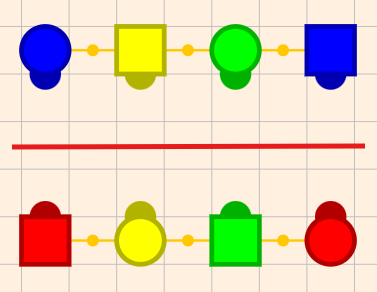
After SQ4; SRT
For stations, we get to divide the square in two however we like and we often choose boxes, but because it is LINES that move across the squares it is useful to divide the square into two lines.
Notice that we ARE in corner station (in each half of the square everyone is with their corner). In particular the bottom half has our focus couple (the red couple), as well as that man’s corner (the yellow girl). Notice that these are the people WE NORMALLY TRACK to resolve a square (we also remember if we are in even or odd station, we know currently we are in odd station (because we are in corner station). I am going to call this kind of line a CORNER LINE (it is a line and we are in CORNER station).
When we do a pass thru, move on, notice that this CORNER LINE moves TOGETHER to the new square. If we STAY in odd station, then all we need to do is make sure that a line with these SAME people moves back together. If what we did was a zero, this would be true, but ALL we need is for the same people to go back together. For example consider the following formation
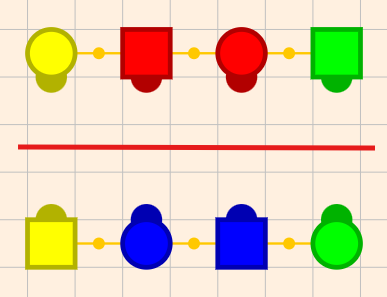
Notice that this is also corner station and if we did a pass thru; move on; the same 4 people would go back to the square they came from. Once these people are back in their original square, you can resolve the square as you would normally do.
The KEY POINT, is that YOU ONLY TRACK THREE PEOPLE ON THE ENTIRE FLOOR (just like for a single square). To keep things simple let us assume you have a RECTANGLE of squares (all rows of squares are the same length) So the basic strategy is as follows
- Get to a ‘corner line’ where all three of the people you track are in a line facing in.
- Move them to another square with a pass thru; move on;
- ONLY allow this group of 4 people to move between squares. (you can do this by making sure that you are in ODD station, and your group of 3 are in the line). You can move to the square above or below, left or right, just make sure they go TOGETHER. Do NOT let your Focus group bounce off the edges of the rectangle of squares (that is when you call ‘move on’ your focus group is ALWAYS moving to a new square).
- When you want to resolve, just retrace your steps of 3 people back to their original square.
- Then resolve as normal.
So the only additional piece of information you need is the ORIGINAL square of your FOCUS couple (and corner). This technique is VERY similar to what is advocated in the ‘station’ paper ‘Controlling Choreography With Relationships’. There they recommend that you get into a station (say corner station), and STAY there for the rest of the patter. In their scheme you can move around, but always with your station person (e.g. corner for corner station). In progressive squares we are keeping the WHOLE group of 4 together and moving around the squares in a similar way.
Note that the reason for the ‘no bounce’ rule in step 3, and the ‘retrace your steps’ rule in step 4 is to keep bookkeeping to a minimum. The issue is that dancers that do the partner trade (I call it bouncing off a wall) change direction, while those who do the ‘pass thru’ part do not. This means that the ‘other half’ of the square associated with your line is NOT always exactly the opposite of your focus line (in fact it usually ‘chases’ the other line). Because of this, getting your focus line back to the original square (say in a small loop around the floor), will NOT guarantee that the other half of the square will make it back too. The easiest way to ensure that both halves of the square make it back is to RETRACE YOUR STEPS. This ALWAYS works because for each half, the ‘way back’ always exactly balances the ‘way out’, regardless of the path. We will relax this requirement later, but for now we keep things simple.
Thus I recommend a very simple path to start: say over 1 up one then reverse and bring them back.
Implementing the Technique
To implement the technique given above, you need to be able to get back to corner lines (or partner lines if you use those), at will, with the lines FACING the direction you want. This is not something you had to do before to resolve, so it is something that needs to be broken down into simpler pieces. We assume you are in the correct station you need for transition (odd if you use corner lines, even if you are using partner lines). We get ready for transition in three steps.
- Get the lines (facing in) oriented the way you want it
- Get your focus GIRLS in the same line using a SRT; CKP; SRT;(star thru, chicken plucker; star thru) if needed
- Get your focus BOY in the same line as the GIRLS using any couple-facing-couple-beside move (e.g RLT; FL).
To implement step 1 you need moves that change the orientation of FACING LINES. Surprisingly Bend-the-line from two-faced lines does NOT do this, but here are some things that DO
- Bend the line from lines (either facing in or out, but out typically has better flow) (e.g. PT; BTL)
- Wheel and Deal, (e.g PT; WHD; C SQ3; SRT)
- First Couple Left Next Right. (e.g. SRT; PTC; DPT; FLNR)
- Centers Split 2 around 1 to a line This call sashays, be careful (e.g. SRT; C S2L; Box Gnat; RLT)
- Cloverleaf (eg. SRT; PTC; DPT; CL; C SQ3; SL)
- Circle to a line (eg. SRT; CTAL)
- Other more subtle ways using Tag the Line, or split circ, Swing thru with BBGG waves.
If after step 1 the two FOCUS GIRLS are in the same line then you can move on to step 3. If not, do a SRT (star thru); CKP (Chicken Plucker) and another SRT which will fix it.
If after step 2 your FOCUS BOY is in the same line as the focus girls you are done. Otherwise you can use any couple-facing-to-couple-beside move (like RLT; FL (Right and left Thru, Flutterwheel)) to get the boy in the same line as the girls.
Finally you can do a pass thru or a Square Thru 3, to get your focus line pointed out the right direction and call move on.
Modules for rotating a line
Generally speaking in traveling squares, you are doing one of two things
- Making you pilot line continue move toward the wall it is currently facing OR
- Rotating your pilot line so it points at the ‘other’ wall (e.g. SIDE wall if it was facing HEADS).
While you can do (2) from first principles following the technique above, it is useful to have memorized some modules that simply do this. It turns out such modules always consist of three components.
- A call that changes walls, as discussed previously (e.g. WHD, CL, …)
- A ‘circulate’ call that causes people from one half of the square to move to the other half (e.g. circulate, trade by, or a pass through from a double pass thru formation).
- A Couple-beside-to-couple-facing call (e.g RFL).
Here are some examples of modules that do this. Note that any time there is a trailing Reverse Flutterwheel (RFL) you can substitute a Pass the Ocean, Girls Trade, Recycle, Sweep a Quarter (or a RLT; FL). You can also substitute a SRT; RFL with a Touch a Quarter, Walk and Dodge, Partner Trade (TQ; WAD; PTD). Thus the first three examples below are really just variations on a theme. You could easily create variations for the others.
PT; WHD; C PT; RLT; VL; BTL;                keeps partners
PT; WHD; C PT; SL; RFL;                     keeps partners
PT; WHD; C PT; SL; PTO; GT; REC; SAQ;        keeps partners
PT; WHD; C PT; TQ; WAD; PTD;                keeps partners

PT; BTL; PTO; CIRC; GT; REC; SAQ;            swap partners
PTO; ST; BR; FW; DPT; CL; C PT; SL; RFL;    swap partners
SL; C S2L; SRT; TB; SL; RFL;                swap partners
PTO; ST; BR; FW; DPT; FLNR; RLT; FL;        keeps partners
PTO; SPLIT CIRC; ST; BR; RFL;               keeps partners
If you want to simply keep going in the same direction, you will want to have a short ZERO between the move on calls. Here are some good zeros.
PTO; REC; SAQ;
PTO; ST; BR; CDTL;
PT; WHD; DPT; FLNR;
PTO; GT; REC; SRT;
SRT; PTC; C SQ3; SRT;
SRT; PT; TB; (ANY CKP SEQ) SRT
However it is also nice to do something that is NOT a zero but keeps your focus line together. This way it is not so obvious that you always transition the same group of 4. Here are some modules that are NOT zeros but keep the focus line together (swapping partners)
PT; WHD; DPT; CL; C PT; SL;           swaps partners
PTO; CIRC; REC; VL; CIRC; CDTL;       swaps partners
PTO; CIRC; GT; ST; BR; CIRC; CDTL;    swaps partners
PTO; CIRC; REC; PT; TB; SL;            swaps partners
PT; BTL; RLT; FL; PT; BTL; RLT         swaps partners
So one way of doing progressive squares is to memorize these modules. This is definitely a good technique, but like patter calling in general, it is good to know how to ‘resolve’ in case you call one of your modules incorrectly. If you remember your focus couple and their corner, and you stay in odd station, and you understand the resolution technique given above (that is how to get your people in a line), then, even if you ‘mess up’ you can recover and complete your tip.
Congratulations! You now know how to do progressive squares.
Coolness with a Rectangular Set of Squares
Finally I should mention that there is a nice property that happens if you have a perfect rectangle of squares. Let’s assume we have 3 squares left to right and 4 squares top to bottom. If you have your focus line in the bottom right corner go three squares to the left it turns out that the ‘other half’ of the square first ‘bounced off the right wall’’, and then ‘chases’ the focus line down the row. On the 3rd move to the left , the focus couple ‘bounces off the left wall’ and the other line ‘catches up’, reforming the original square (but now in the lower left corner). At this point you could ask the dancers to promenade home (now in a different location).
Similarly if you have your focus group move 4 squares up all the squares will reform at the ‘mirror image’ position. Thus you don’t have to ‘go out and come back’ and reform where you started, you can ‘go out’ and end your tip after everyone has moved to their mirror image position (which is probably even cooler than getting back to the square’s original position on the floor).
Note that you DON’T need to go ‘all in one direction’ and then ‘all in the other’. You can keep zig-zagging across the rectangle as long as your focus couple ‘bounces off’ exactly once off the left-right wall and once off the top-bottom wall.
Jagged Sets of Squares
If you don’t have a perfect rectangle of squares (e.g. 5 squares in a row of 3 and a row of 2), the technique in the section above will NOT work because dancers in different rows/columns bounce off the walls at different times leading to chaos. However the ‘retrace your steps’ technique (described first), will ALWAYS WORK, even in the jagged case. This is not as impressive as reforming the square somewhere else, but it is still pretty cool.
Working with 3 squares
The most likely jagged setup that you will work with is 3 squares. Now you might think that with three squares in a jagged formation that you could do just a ‘PASS THRU; MOVE ON; operation twice in the same direction and that would be a no-op (all your original square is back together again). The rationale is that this sequence would work with JUST a row of two squares, and dancers in the ‘lone square’ never leave their square and thus should be fine. I thought that at one time, and I WAS WRONG. The reason is that when you ‘bounce off a wall’ (which is what one line is doing whenever you do a PASS THRU; MOVE ON) , you SWAP ORDER. Thus after doing two PASS THRU; MOVE ON operations it is true that all squares have their original people in them, but the row that has two squares your focus line bounced off the wall exactly once, whereas the row that had only one square the line bounced off of two walls. This means some squares have done the equivalent of a right and left thru, while other squares have not. Thus if you try to resolve and promenade home some square on the floor will be wrong.
The straightforward way to fix this is to simply fix the lonely square. After doing Pass thru move on, twice and while your focus line is still in a line, simply ask the square that never interacted with another square to do a right and left thru. That will put all the squares in the same place (you can resolve). Then I would suggest that you make your focus line go in the other dimension so that every square gets to interact with other squares.
You can of course do this with other odd numbers (like 5), but in the case of 5, you will not be able to go in the other dimension because there is not a singleton square in that direction. Thus the odd square will never get to participate (sad). To get everyone participating you will need to go out and retrace your steps (which is OK).
Singing Call Progressive Squares
Unfortunately the technique above where you ‘move on’ to an adjacent square does not work in a straightforward way with a singing call. There are two reasons for this.
- As we noted before, when you exchange a line of dancers with an adjacent square you MUST exchange a Number 1 man (that is the head man with his back to the caller) with a number 3 man (the head man facing the caller). Because of this you end up with a square where two men think they belong in the number 1 position, and the square will crash on a promenade.
- Unlike patter, in a singing call, the ladies are rotating around the square and that adds another layer of complexity to get everyone back together if you are progressing between squares on every figure.
There are a number of ways to try to get around these issues, but I happen to like the one I am about to explain. It is inspired by a ‘scatter promenade’ which a group of friends can do at festivals. The idea is that when a PROMENADE happens, everyone leaves their square (as couples) and promenades to a new position in another square, and you continue dancing. Typically only a small handful of squares do this and they go to nearby squares. There is certainly a lot of chaos in the transition (it often takes time for everyone to find a new square) and you certainly don’t end up with your original partner, but the chaos can be fun if everyone has a free-spirited outlook.
The interesting question is: can we do something LIKE a scatter promenade, that avoids the chaos and allows people to end up with their partner at the end of the singing call? Surprisingly, the answer is YES and this is the technique I will describe here.
First to use the technique, the squares need an ORDER, that is each square needs to know what the ‘NEXT’ square is. For most venues, this is easy, you just think of the squares on the floor as forming a ‘ring’ and the next square is always the square in the counter clockwise (promenade direction). This works well, for numbers of 8 squares or less, but for 9 squares (a 3 x 3 grid) there is a problem with the very center square. You can fix this either by avoiding the center square (push it into the outer ring), or simply have multiple rings (you can have a ring of size 1 in your 3x3 grid, it just means that the very center square will not progress (it progresses to itself)). The rings can nest if you like, or they can be adjacent rows of a grid (if you have an even number of rows). All that matters is that every square is reasonably close to its NEXT square (rings do this naturally), and that everyone knows which square is their next square.
You also need to teach a new move called ‘PROMENADE HEADS (or SIDES) PROGRESS’. When you call this it means that as the promenade happens the heads (and only the heads) promenade to the NEXT square on the opposite side (thus the #1 couple becomes the #3 couple and vice versa). Another way of thinking about this is that the heads promenade ½ way but to the NEXT square. The reason for only promenading to the opposite side is that it is SHORTER (since they also have to get to the other square), and you will find it VERY NATURAL to SLOT IN behind the SIDES who are promenading normally. It is a happy fact that this works so well. You can see the scatter promenade inspiration in this move, but because we only ask HALF the square to leave, the half that stays acts as a ‘scaffold’ to reconstruct the square. We are also giving the couples that do progress (scatter) a definite destination and this destination is CLOSE so it will not take much longer than a normal promenade. This eliminates the chaos.
You will want to practice this a few times in patter so that people get the hang of it. You also must warn them
- Progressing gives the boys a NEW HOME (across the square) Thus they have to remember to come back to this home until the next time they are asked to progress. Trying to go back to their original home is the most likely thing to make the squares crash, but luckily the fact that SIDE couples get in their way if they try to go to the wrong home will usually ensure that they can recover from it reasonably quickly.
- When you first practice it in patter, have them promenade their partner (that is do an allemande left your corner and then promenade your partner home HEADS PROGRESS).
- During the actual singing call the LADIES WILL PROGRESS AS NORMAL (that is you SWING your corner and promenade this new corner home. However when you call HEADS PROGRESS you are referring to the BOYS (since the side lady progressed to the head position). In short, ladies promenade home with whoever they swung as is normal for a singing call.
Once you have taught the dancers HEADS (SIDES) progress, the technique is pretty simple you do a singing call as normal (opener, two figures, middle break, two figures and a closer), but during the first two figures you ask the HEADS to progress on the promenade and on the last two figures you ask the SIDES to progress. If you do this everyone ends up with everyone they started with but the whole square moved two positions on the dance floor around the ring. They will have also danced with dancers from 2 other squares besides their original square.
As always, if the square breaks down, ask the dancers to form a static square with SOMEONE waiting for the next figure. Note that you may end up with too many dancers for one square (basically someone forgot to progress). The ‘extra’ couple needs to get the square that is missing someone (which SHOULD be nearby). Stress to the dancers that you HAVE TO PROGRESS if the caller tells you to.
Tips for Singing Call Progression
- YOU MUST progress HEADS twice FIRST and then the SIDES twice. DO NOT alternate them in a singing call because it interferes with the ladies progression and dancers will not end up with their partner in the end.
- At least initially use a singing call with a CIRCLE LEFT figure for the middle break and closer (that is no grand squares, or stars). This is because CIRCLE LEFT figures are VERY ROBUST if you start them late, so if there is some chaos during the progression, you can wait for the slow dancers and recover. Remember the whole floor succeeds or fails together.
- Use SHORTER figures (e.g. 33 beats, NOT the usual 36-38 beats) because this gives the dancers some extra time to do the progression (or recover from a mistake). I would use the same figure each time, because they have enough to worry about.
Six Couple (Rectangular) Squares
There will inevitably come a time when the turnout for a dance is not great, and you have 6 couples but not 8 people to dance. In the worst case you have 15 people and thus 7 people have to sit out. This is when it is useful to create 6 couple squares (rectangles).
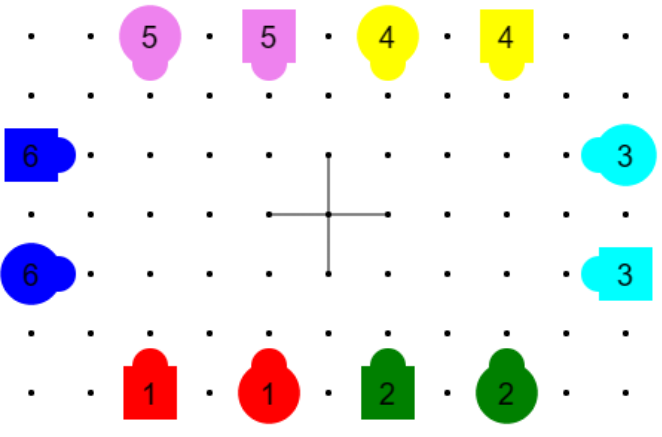
I used to think that calling for 6 couple squares would be ‘hard’ because you would have to remember the home position of 3 couples, and would require remembering more. It turns out it is NOT significantly harder to call for 6 couple squares IF YOU FOLLOW SOME RULES that allow you to LEVERAGE your 4 couple square knowledge. You can EVEN do singing calls THAT do full lady’s progression if you want. Because it is EASY, it is nice to have this in your ‘toolkit’ if you even have dances with 12-15 people. It is ALSO useful as a WORKSHOP novelty because you can teach dancers slightly strange moves (like bend the line or wheel and deal from lines of 6), which are novel and fun.
What is Different in 6 Couple Squares
Obviously the main difference between 6 couple and 4 couple squares is that you have more heads than there are sides. However because 80% of all calls are 2 COUPLE moves (they only need 4 people to do the move), ‘most’ moves ‘just work’. However when you have lines of 6 (instead of 4) like this
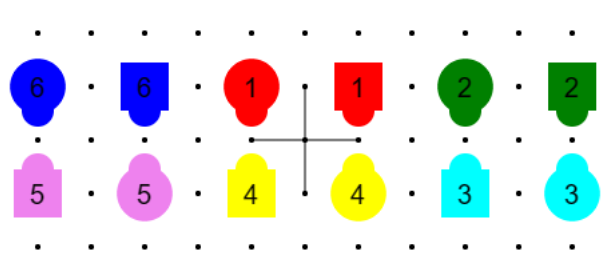
After h lr; vl; btl;
AND you are doing moves that are not ‘two couple’, then you run into issues. The most important moves that are problematic are:
- Bend the Line from lines of 6 (not two faced).
- Wheel and deal from lines of 6 (that is lines facing out).
There are a few others, but they are rarer (Split 2 around 1, Separate around 1 …) Note that both Bend the Line and Wheel and deal CAN be done from TWO FACED LINES OF 4 (which you can form).
You will also find that double pass through formation in rectangles is weird. Moves that you would expect to form a double pass through formation like Dive Thru, Pass to the Center, or Ferris Wheel end in this formation
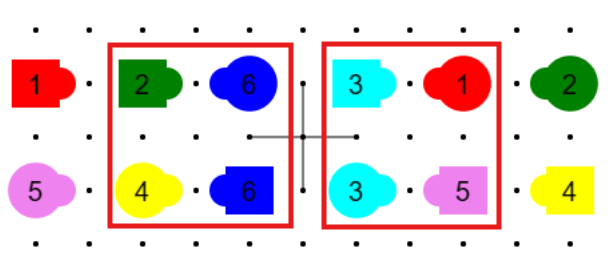
Notice that the very centers (couples 6 and 3) are pointed in a way that is opposite of the way you were probably expecting. You would NOT want to call a double pass thru (dancers would be confused). Note that while you can’t call double pass through from this formation you CAN call Centers Pass Thru or Centers Square Thru 3 from this formation and it works (you may have to get the dancers familiar with the concept that there are TWO groups of centers (highlighted in red boxes above), but dancers take to it quickly. I will call this formation the ‘centers active’ formation because it sets up the centers to do things without the ends (and calling it double pass thru would be at best misleading).
Because we can’t call double pass thru, getting to a completed double pass through configuration is also problematic, which means moves that rely on that formation like
- Cloverleaf
- Centers In
- First Couple Left next Couple Right
Do not work without modification.
So there are a bunch of calls that ‘don’t work’. The other main point is that
- Heads can do things that the sides cannot.
In particular your first calls to get you ‘to the grid’ will be to the heads. Square Thru *, and Lead Right both work, but only for the heads. There are a few things the sides can do, but it is questionable whether they are worth calling.
What is The Same in 6 Couple Squares
What is amazing, however, is that SO MUCH just works in 6 couple squares. In particular, as a general rule, if you have a ZERO MODULE for a 4 Couple square and it is LEGAL in a 6 couple rectangle, it is very likely a ZERO MODULE in a 6 couple rectangle. In particular MOST singing call figures in Square Dance Figures work (unless they hit bad formations). This is absolutely FABULOUS because it means that you don’t have to LEARN new singing call figures to call 6 couple squares.
Note that, sadly, Heads (Sides) Promenade ½ is a problematic call and it is used commonly in singing call figures. The good news is that you can substitute Heads Right and Left Thru, for the heads promenade ½ and the figure will probably work.
To prove sequences work for 6 couple squares, I have made a ‘Taminations Sequencer’ like program that works for 6 couple squares
It works very much like the taminations sequencer (but it is not animated, it just shows the final formation). Try out the figures and modules you know and see which ones work.
The fact that so much of what was DESIGNED for 4 couple squares just works on 6 couple squares is nothing short of amazing. It means that you can IMMEDIATELY try 6 couple squares in your patter simply by using the singing call figures you already know.
Resolving in 6 Couple Squares
But wait, it gets better. Not only do most of your singing call figures work, your RESOLUTION techniques work! This blew my mind. It turns out that the restrictions on what you can call (because they lead to problematic formations) have an important side effect: they keep the boys and girls in circular order. Consider the following formation after a bunch of calls were made.
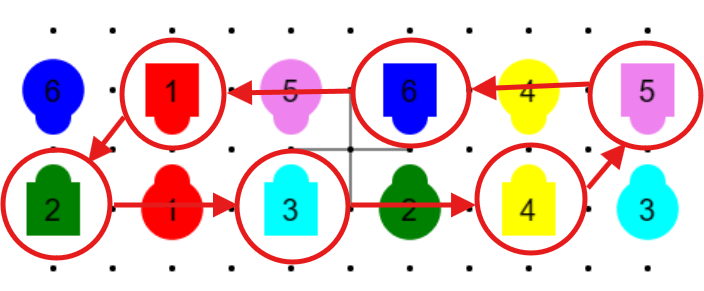
It looks pretty messed up at first, but if you look at JUST the boys, you will notice that as you go around the formation they are in order. Notice it is also true for the girls. Now sometimes the order is clockwise and sometimes it is counter-clockwise, but it is ALWAYS the case that the number 3 boy is between the number 2 and number 4 boy. TRY IT ON THE SIMULATOR! You can’t break this invariant (without using illegal/modified calls).
This has a REALLY important property:
Normal 4 Couple Resolution Will work
In particular to resolve
- Get to odd station (you remember this, just like in 4 couple)
- Get to 2 faced lines (you will have three of them for 6 couple)
-
Get your focus couple in the same line (our focus couple is the red couple) by using either girls trade or couple circulate (or both). For 6 couple the worst case is the following
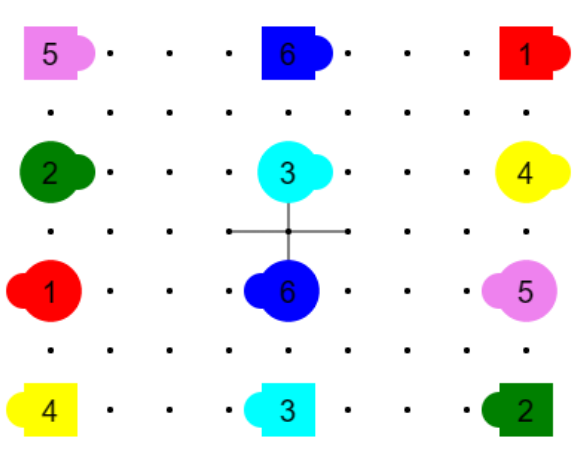
Worst case to get red couple in same line
This is the worst case because the red couple is ‘far apart’ and ‘pointed apart’. Notice however that two couples circulates will cause the red couple to meet in the middle line. Note that in the technique that uses girls-trades and couples-circulates will work for 6 couple but it might be tedious. The basic idea is that you get the girl to the END line (using couples Circulates) and keep her facing OUT (using girls-trade) so that when you couple circulate she stays in that line as the boy gets closer. In the case above, three couple’s circulates will do it. That is pretty tedious, so you probably just put some random zeros in there to hide what you are doing.
4. Get your focus couple to the end line (not the middle line) We did not need to do this in 4 couple squares because every line was an end line. Since your focus couple is in the SAME 2-faced lines already, either they are a couple, or you can make them a couple by doing a girls-trade. The couples circulate will get them out of the middle line.
5. Get your focus couple to the ends as a couple facing in. This works as in 4 couple squares.
6. Do CKP (Chicken Plucker) as needed to get your focus boy facing his corner (who you remembered). This is where the magic of keeping people in order comes into play. Because people are kept in order, the only people ‘nearby’ our red #1 boy are his corner (the blue #6 girl) and his ‘right hand lady’ (the #2 girl, who happens to be a head). Thus if you are not already resolved, a CKP will swap the corner and right hand lady and resolve the square.
The key point is that RESOLUTION basically works unchanged. I encourage you to ‘mess up a square’ remembering only a focus couple and a corner for that couple and resolve it. It should just work.
Singing Calls in 6 Couple Squares
Two notable things are pretty obvious
- Right and left Grands, and weave the rings need 7 hands instead of the normal 5 hands to get back to your original partner. You need to tell the dancers that (OR see below for an alternative)
- Promenades (or anything else that ‘goes around’ the full circle) take longer in a 6 couple square. This means that grid figures in singing calls need to be shorter so that there is more time for the promenade.
While the fact that promenades take longer seems obvious there is an exception to this rule.
- The standard opener (Circle left, Allemande Left, Dosado, Allemande Left, Weave the Ring, Promenade home), DOES NOT TAKE LONGER (if you are careful and let the dancers circle left at least ½ way (in normal singing calls you circle one full cycle, so it is not hard to circle left at least ½ way)).
This surprised me when I learned this, but the reason for this is the same reason why this sequence is ‘MAGIC’ and can take longer or shorter depending on how long you call ‘circle left’ The reason is that the sequence is not really a LOOP. The dancers go left, do stuff, and then come back. Notice that the distance they go DOES NOT DEPEND ON THE NUMBER of dancers but rather HOW LONG YOU CIRCLE LEFT. Thus it is the same for 6 couple squares as it is for 4 couple Squares (this is very nice). The key to making this work however, is that the ‘circle left’ has to be long enough so that the ‘weave the ring’ does not ‘overshoot’ home (which forces the dancers to promenade once around, which will take very long). Normal singing calls naturally ‘circle left’ long enough.
Weave the Rings
As mentioned, to make a right and left grand, or a weave the ring a ‘no-op’ (that is you come back to the person you started with) in a 6 couple square, you need to advance 7 hands instead of the regular 5 hands. Definitely have the dancers count the number of hands so they don’t forget. There is an alternative, however, which is to do some other call that moves the ladies TWICE in the weave direction (that is ladies to the left men to the right as you face in). This is most often done by doing a ROLLAWAY TWICE). You can also have the ladies chain 2 people. Once you do this, you can then tell them to only go the standard 5 hands.
Ladies Progression
So the good news is that we use the standard opener, it will not take any more time (great). However normal figures will have us ‘swing and promenade’ and those promenades WILL TAKE LONGER. So this means we should pick SHORT figures to give dancers more time for the promenade. Since Square Dance Figures comes with a set of ‘short’ figures, and we memorized one or two in case dancers fell behind, we will just use one of those. Choose figures that are around 30 beats.
But we still have a problem. Ladies have to progress 6 times, but we only have 4 figures. The easiest way to solve this is to have the MIDDLE BREAK and CLOSER advance the ladies. It turns out that this is pretty easy. If you simply add a SINGLE ‘ladies center men sashay’ to your circle left, in that figure, then whoever was your corner before becomes your partner (that is the ladies advanced). This assumes that you are doing a 7 hand right and left grand. Note that if you do a single ROLLAWAY and a 5 handed right and left grand (or weave), it will also advance the ladies one position, so either option is possible.
So the rules for 6 couple singing calls are
- Use the standard ‘circle left’ figure with a 7 hand weave. This is a no-op
- Use short (30 beat) figures
- Add a ladies center men sashay to the middle break and closer (note that the weave the ring is 7 hands). This advances the ladies for these two figures.
That is it! Alternatively you could
- Use a circle figure with TWO ROLLAWAYS with a 5 hand weave. This is a no-op.
- Use short (30 beat) figures
- For the middle break and closer, use a circle figure with a ONE ROLLAWAY and a 5 handed weave the ring. This advances the ladies for these two figures.
You can now do 6 couple singing calls!
Grand Square
For your first 6 couple singing calls, I would stick with the ‘circle left’ opener. However it turns out it IS possible to do a grand square with 6 couples. It comes with TWO caveats.
-
YOU WILL HAVE TO WALK THROUGH A TEACH WITH THE DANCERS. The key to doing a grand square is that VERY CENTER people (e.g. #1 girl and the #2 boy)
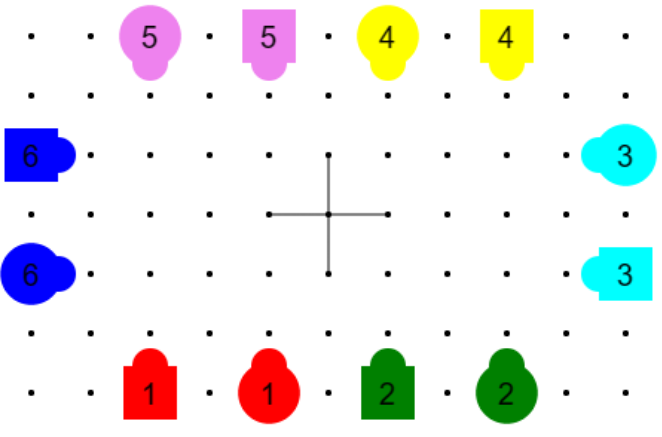
are NOT doing what they would normally do on a grand square. They are used to facing their PARTNER after taking the first three steps, but now they face EACH OTHER. When I teach Grand Square I mention that you will ONLY face your PARTNER OR your OPPOSITE, and you will alternate. For these very center people, they will face their OPPOSITE or EACH OTHER (not their partner). If they do this everything works.
Note that it does not hurt to tell the sides that half the time they have to take bigger steps so they get past both head people, but generally they figure this out without instructions.
-
The grand square does take the same amount of time as with a 4 couple square, HOWEVER typically afterward you call an ‘Allemande Left; Weave; Promenade’ which WILL take longer (because of the promenade). You should substitute a SHORT Circle Left, Allemande Left; Promenade instead. (by SHORT what I mean is that you only circle left slightly over ½ way. We skip the weave the ring because if you are not careful you will end the circle left too soon, and the weave the ring will ‘overshoot’ home. By promenading you avoid that possibility).
I would only do a grand square with 6 couples if the dancers were above average AND I was feeling adventurous. When in doubt, skip it.
Three Couple Moves
The reason that things ‘just work’ in 6 couple squares is that whenever you do a move that requires more than 4 dancers, you do it along the axis that has only 4 dancers in it. This is what keeps everyone in order. It is possible, however, to do such moves along the 6 dancer axis. For example you can bend the line when lines of 6 are facing, however now you have to break the lines BETWEEN the center two dancers to form lines of six on a new axis. You can also modify wheel and deal, so that it forms a triple pass thru formation. You can also add a new call ‘stretch ferris wheel’ which also forms a triple pass thru formation. Once you have a triple pass thru formation, other moves like cloverleaf, cast off ¾ and first couple go left, next couple go right work. If you are interested in these moves just try them out on the Six Couple Simulator to see how they work.
However, I should note that there are definite disadvantages to trying to use these moves.
- These moves will break the sequential order in the square, which means that 4 couple resolution techniques will NOT work. There are resolution techniques that DO work, but they require that you remember the ordering of 3 couples (not just 2), which is a NON-TRIVIAL thing to learn to remember, and the resolution technique is more complex.
- The other problem of course is that you have to teach the dancers these new moves. If the goal was to do something new/exciting, this is a PLUS (so you can do it for a workshop), but if the goal is just to allow 6 dancers to dance, then it is not worth it.
You can mitigate the resolution problem by doing something very similar to what we did to make corner box patter calling more interesting. Remember in that technique we got to a corner box (that is H SQ4), and then STAYED THERE. We made this more interesting by allowing ourselves to leave (e.g. calling a CKP), but immediately got back (by calling another CKP). In this case we can call these 6 dancer axis moves (which could break resolution), but immediately come back to a safe formation (when all the dancers are in order around the rectangle). Here are some sequences that do this.
- pt; btl; (Any 2 Couple Zero from lines) pt; btl;
- pt; whd; zoom; triple pass thru (tpt); first left next right (flnr);
- stretch ferris wheel (sfw); zoom; zoom; tpt; flnr;
Note that these are not zeros, they are moves that keep the boys (and girls) in order around the rectangle. You will need to (4 couple) resolve the square from there. If you want to pursue this then experimenting with the Six Couple Simulator is definitely called for.